1.
a) 0
b) 17
c)
d) D.N.E.
In other words, you are looking for an indeterminate case where you get zero in the numerator and zero in the denominator, such that it has the following properties: the limit is 0 or 17 or
Then we were to attempt to find the following equations without technology:
2.
a)
b)
c)
Before the class revealed their answers, Mr. O'Brien commented on a key idea which is that a function doesn't have a limit in general, it has a limit at a point. So you are never going to just a
Next, in order to test our answers we checked to make sure we had a fraction limit and also that both the numerator and the denominator were zeros. And in order to find the limit values, we used a table to evaluate our functions.
By looking at the table we declared that an answer to a) for the first question is
Next, in order to find an answer to b) for the first question, we decided to look at the problem algebraically. We created the function
In order to find where the limit D.N.E., instead of creating a hole, we need to create a gap, a break, or a non removable discontinuity. And in order to get that we need to include absolute value on the numerator so the equation looks like this:

Overall for all three problems Mr. O'Brien emphasized that if you have any function you can add a hole to it and it does not change the limit value.
Lastly for c) we got
Next we evaluated the infinite limits for question 2 without a calculator. The first one is a natural log function which means the domain is everything above zero, there is no y intercept, and the x intercept is 1. Now to evaluate
Now for b) and c) of question 2 it helps to think about how fast the fractions are growing. For b) the limit is approaching zero because the numerator is approaching infinity slower than the denominator. For c) the numerator is growing so much faster than the denominator making the limit be infinity.
Next we evaluated the quiz. An important not was that for number 4 you need to include the actual value which is
Next we "NAG" (to take a look at the numeric, algebric, graphic) the function

We now turned our attention to The Squeeze Theorem (aka The Sandwich Theorem) which states: If
We then reviewed an example of this which is

 Here we can see a visual of the squeeze therom. We know that the limit of both
 Next in order to look at
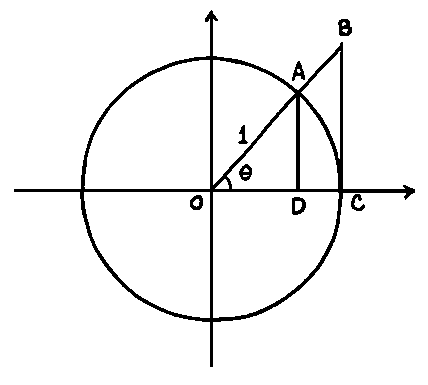
In the diagram: AD=
Now by using
then multiplied by 2 and got:
then we divided by
Lastly, we reciprocated the following equation and got:
Now since
An additional diagram that might be helpful is the one Lange used in her blog:

In the last two minutes of class we were not able to complete two example problems which would help further our understanding of this theorem. So, it would be helpful to review example 3 and 4 on page 87-88 tonight before the homework. In addition, the following website http://www.math.ucdavis.edu/~kouba/CalcOneDIRECTORY/squeezedirectory/SqueezePrinciple.html provides numerous examples of the Squeeze theorem which will help as well.

No comments:
Post a Comment