Today we started class by looking at Sophie's blog post about Newton's Method, and discussed how using spreadsheets can be very helpful in speeding up the process of Newton's Method. Next, we talked about TI 89 calculators. They are amazing and can do it all, so if you want to borrow one, just talk to Mr. O'Brien, cause he has a bunch of extra and unused ones.
Next we moved on to Unit 3, which is all about the physical application of derivatives, and involves a lot of word problems.
We started with an example about a square: you have a square and the sides increase at a rate of 2cm/sec. When it has sides of 4X4, what is the rate of change of the area?.. Solve with no calculus, just middle school math.
We said that x (the side length) has a constant rate of change, but the change in area was not. We compared the square when it was a 4X4 at t=2 (the starting value for time) and when it was 6X6 at t=3 seconds. We said that the rate of change over the interval

was the

or

which equals 20. But this wasn't the rate of change at exactly the time when the box is a 4X4, so we did the same thing with smaller and smaller intervals. We did t=2 and t=2.1, and t=2 and t=2.01. Then Ann suggested we used the idea from the symmetric difference quotient in this situation. So we did the changes in the rates for t=2.01 and t=1.99, and found the rate of change to be 16 cm2/sec. This is the instantaneous rate of change at the moment in time when the square is a 4X4. We know from calculus that this instantaneous ROC is the limit, and that we can find the ROC using calculus and it would be a lot less work.
This brought us into the idea of Related Rates. These are problems where there are variables that change with varying time. To understand this better we looked at the example of

as well as a #14 and #18 on page 206.
For the problem of a
we said that

= 2 cm/sec and we were trying to find

. (where x is the side length, t is time, and A is area)
The first step is to take the derivative, remembering that you have to use implicit differentiation and the chain rule, and that there is always a derivative for varying parts.
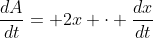
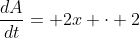

When x is 4,
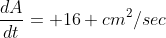
We then moved onto the book problems, and Mr. O'Brien said that know formulas (like for volume and area) are important, and that if we forget them we can just google it.
#4 on p. 206 asked about a cone, with radius r and height h. We used the equation for the volume of a cone:
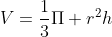
. Part a asked how the derivative of Volume with respect to time is related to the derivative of height with respect to time if r is constant. To do this, we first took the derivative:
1. We said that

was a constant (since r was a constant for this question) and therefore when we took the derivative it looked like this:
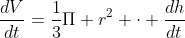
. It is very important to remember the chain rule with these problems. Therefore the answer to the problem was that dV/dt is directly proportional to dh/dt if r is constant.
We then did part b, where h is constant, which was largely the same process, just with different variables.
Part c said r and h were both variable. In this case, it was necessary to use the product rule. We still said that the 1/3π was a constant, so we took it out as we found the derivative of h and

using the product rule (without forgetting to use the chain rule when necessary). What we found was that there was a complicated relationship that looked like this:

.
We then did another example, #18 on p. 206 which was a word problem about water flowing from a conical pile. When doing these kinds of word problems, there are some steps that make it a little easier.
1. Read the problem carefully
2. Make a picture
3. Identify what the variables are and the different rates
4. Find which equations you're going to need
5. If you can, combine variables by subbing in and using pre calculus math
There is homework with more of these problems, and Mr. O'Brien said that's its important to look at them all so that we can get used to solving them, and there's a supercorrections test on wednesday.
Here's a good site that gives some steps for solving related rates questions and has some animations.
http://astro.ocis.temple.edu/~dhill001/relatedrates/relatedrates.html
UPDATE
The most important part of solving related rates problems is to clearly understand the problem before beginning it, so all the variables and constants are related correctly. This site: http://tutorial.math.lamar.edu/Classes/CalcI/RelatedRates.aspx has a lot of good examples and explanations. This video: http://www.youtube.com/watch?v=Zdc6Ih-ROt8 shows a related rates problem with trigonometry, and he makes it pretty easy to understand despite a little cold. Another important thing to remember about related rates is that they use implicit differentiation, so it's important to remember which variables go where and to remember all the dx and dy's.


