Assignment #9 solutions
Assignment #10 solutions
Assignment #11 solutions
Assignment #12 solutions
Friday, October 29, 2010

Friday, October 29 - FINISHING DERIVATIVES!
We're a quarter of the way there, everyone!
Class was 10 minute shorter today because CHills loves its football team. First we talked about the last quiz. It didn't go so well... so Mr O'B said that if anyone decides not to count this quiz grade, that would be okay with him.
The solutions are online, but here are the specific things we went over on the quiz:
#1. Set the equation up like (tan(4x/5))^3 and then proceed.
#3a. Use either calculus or the quadratic equation to find the x- and y-coordinates of the maximum point. Putting those 2 coordinates into (f)' gives you the slope. Put it all together and what do you got? Bippity, boppity, normal line.
b. Here you are looking for two vertical lines - you don't need point-slope. Set your derivative equal to zero and solve.
#4. Use implicit differentiation to solve. Remember when you take the derivative of a y term, you need to take the derivative of that y part and then multiply by y'.
#5. The velocity curve changes direction when the slope goes from negative to positive. To draw the speed curve, just change all the negative values to positive values.
#6. It was agreed by all present that this one was a toughie. Use the Quotient Rule - pay attention to order! And remember this trick - when you take out the greatest common factor, that will help you cancel and simplify. There may be one like this on our next Opportunity Day...?
#7. Ch-ch-ch-chain rule. The derivative of e raised to a power is itself. Then you need to multiply that derivative by the derivative of the power. This one is similar to 27-57 on Assignment #9.
#8. Use Product Rule and treat x and as separate functions.
Whew.
Words of wisdom from O'B: be economic with your space, keep your work clear, and (DEFINITELY)^3 figure out what you did wrong on quizzes after you get them back.
We talked about how d/dx [y] means the same thing as dy/dx - the derivative of the function y. (We quickly went over derivative notation in relation to slope. If you still don't understand, check out http://www4.ncsu.edu/unity/lockers/users/f/felder/public/kenny/papers/dx.html to get a clearer idea of this. But Mr. O'B said not to stress it too much.)
Then we said goodbye to Collin and talked about Part II of the exploration. The solutions for this are online.
In #2, we transformed y=lnx into y' by using implicit differentiation. So, this is a new derivative to know:
 .
.
Question: should we memorize this or just be able to derive it from ?
?
Answer: Memorize it.
Check out this graph for a visual connection to the derivative of the natural log function.

#4 talks about the derivative of an inverse function, which is going to be (1/the derivative of its inverse). In other words,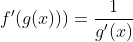 . We found this relationship by differentiating with the chain rule idea that f(g(x)=x.
Then we opened up Geogebra to look at inverse functions. We graphed . Dan chose an x-value, 3, and we used the function to find the point (3,6) - in blue on my graph. Next, we found the inverse function by using basic log rules:
  . We added the inverse point (6, 3) - in black on my graph.
 Note: the x and y scales on these axes are not equal.
Then we tried to find an equation of the tangent to f(x) at the "Dan Point" and an equation of the tangent for g(x) at the "Inverse Dan Point". You can do this using your TI by can find the slope with nDeriv - but in the graph window you can do Calc and option 6: dy/dx!
We found both our tangents at the Dan Point (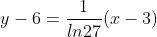 ) and the tangent at the Inverse Dan Point.
Here's the previous graph with the tangents added:

In this graph, the red line is the derivative to f(x) at Dan's Point, A. The purple line is the derivative to g(x), the inverse of f(x), at Inverse Dan Point, B. The dotted line is at y=x to show that f(x) and g(x) really are inverses.
Finally, we used Wolframalpha to find the derivatives to the Inverse Trig functions:
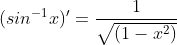
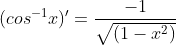
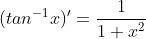
We quickly went over what an inverse trig function means - you are using a trig value to find the angle that has that value. For example, is asking you to find the values of x for which cos(x) = 1.
If you'd like to see some proofs of the inverse trig derivatives, check out this helpful site. Just click on the one you want and it will take you to that proof: http://www.themathpage.com/aCalc/inverse-trig.htm#arcsin.
Keep up with homework. We have three days of review before the Unit 2 TEST! Happy Halloween everyone!
BLOG POST UPDATE:
Here is a simple diagram to help demonstrate how a trig function and its inverse are related:
 For a step-by-step proof of the derivative of the inverse sine function, check this out:
Begin:
Take the sin of both sides:
Take the derivative of both sides:
Simplify:
But since we want this derivative to be in terms of x and not in terms of y, let's use the Pythagorean trig identity to simplify.
Pythagorean Identity:
Sub in for y using earlier equation:
Solve for cosy:
Since we're taking cosine of an inverse sine (which would be in the first or fourth quadrant), we know we need the positive value. So...

Then sub this back into the equation we found for y':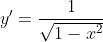
So,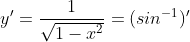 !
!
To find the derivative of inverse cosine, you would follow the same process but use different substitutions. Remember to pay attention to negative signs.
That's all for now folks.
Class was 10 minute shorter today because CHills loves its football team. First we talked about the last quiz. It didn't go so well... so Mr O'B said that if anyone decides not to count this quiz grade, that would be okay with him.
The solutions are online, but here are the specific things we went over on the quiz:
#1. Set the equation up like (tan(4x/5))^3 and then proceed.
#3a. Use either calculus or the quadratic equation to find the x- and y-coordinates of the maximum point. Putting those 2 coordinates into (f)' gives you the slope. Put it all together and what do you got? Bippity, boppity, normal line.
b. Here you are looking for two vertical lines - you don't need point-slope. Set your derivative equal to zero and solve.
#4. Use implicit differentiation to solve. Remember when you take the derivative of a y term, you need to take the derivative of that y part and then multiply by y'.
#5. The velocity curve changes direction when the slope goes from negative to positive. To draw the speed curve, just change all the negative values to positive values.
#6. It was agreed by all present that this one was a toughie. Use the Quotient Rule - pay attention to order! And remember this trick - when you take out the greatest common factor, that will help you cancel and simplify. There may be one like this on our next Opportunity Day...?
#7. Ch-ch-ch-chain rule. The derivative of e raised to a power is itself. Then you need to multiply that derivative by the derivative of the power. This one is similar to 27-57 on Assignment #9.
#8. Use Product Rule and treat x and
Whew.
Words of wisdom from O'B: be economic with your space, keep your work clear, and (DEFINITELY)^3 figure out what you did wrong on quizzes after you get them back.
We talked about how d/dx [y] means the same thing as dy/dx - the derivative of the function y. (We quickly went over derivative notation in relation to slope. If you still don't understand, check out http://www4.ncsu.edu/unity/lockers/users/f/felder/public/kenny/papers/dx.html to get a clearer idea of this. But Mr. O'B said not to stress it too much.)
Then we said goodbye to Collin and talked about Part II of the exploration. The solutions for this are online.
In #2, we transformed y=lnx into y' by using implicit differentiation. So, this is a new derivative to know:
Question: should we memorize this or just be able to derive it from
Answer: Memorize it.
Check out this graph for a visual connection to the derivative of the natural log function.

#4 talks about the derivative of an inverse function, which is going to be (1/the derivative of its inverse). In other words,
Then we opened up Geogebra to look at inverse functions. We graphed
 Note: the x and y scales on these axes are not equal.
Then we tried to find an equation of the tangent to f(x) at the "Dan Point" and an equation of the tangent for g(x) at the "Inverse Dan Point". You can do this using your TI by can find the slope with nDeriv - but in the graph window you can do Calc and option 6: dy/dx!
We found both our tangents at the Dan Point (
Here's the previous graph with the tangents added:

In this graph, the red line is the derivative to f(x) at Dan's Point, A. The purple line is the derivative to g(x), the inverse of f(x), at Inverse Dan Point, B. The dotted line is at y=x to show that f(x) and g(x) really are inverses.
Finally, we used Wolframalpha to find the derivatives to the Inverse Trig functions:
We quickly went over what an inverse trig function means - you are using a trig value to find the angle that has that value. For example,
If you'd like to see some proofs of the inverse trig derivatives, check out this helpful site. Just click on the one you want and it will take you to that proof: http://www.themathpage.com/aCalc/inverse-trig.htm#arcsin.
Keep up with homework. We have three days of review before the Unit 2 TEST! Happy Halloween everyone!
BLOG POST UPDATE:
Here is a simple diagram to help demonstrate how a trig function and its inverse are related:
 For a step-by-step proof of the derivative of the inverse sine function, check this out:
Begin:
Take the sin of both sides:
Take the derivative of both sides:
Simplify:
But since we want this derivative to be in terms of x and not in terms of y, let's use the Pythagorean trig identity to simplify.
Pythagorean Identity:
Sub in for y using earlier equation:
Solve for cosy:
Since we're taking cosine of an inverse sine (which would be in the first or fourth quadrant), we know we need the positive value. So...
Then sub this back into the equation we found for y':
So,
To find the derivative of inverse cosine, you would follow the same process but use different substitutions. Remember to pay attention to negative signs.
That's all for now folks.
Sunday, October 24, 2010
Links for Monday-Wednesday
Exploration
Geogebra File
Solutions to Part 1 of Exploration (to be posted Tuesday)
Solutions to Part 2 of Exploration (to be posted Thursday)
Geogebra File
Solutions to Part 1 of Exploration (to be posted Tuesday)
Solutions to Part 2 of Exploration (to be posted Thursday)
Friday, October 22, 2010
Wednesday, October 20, 2010
Four years free college at USM
Interested in 4 years of college and a laptop for free? This is a pretty cool opportunity:
USM Pioneers
USM Pioneers
Sunday, October 17, 2010
Friday, October 15, 2010
Thursday, October 14, 2010
Scribe Post for Wednesday October 13th
Today in class we started by looking over our unit quiz again. Mr. O'Brien showed us that nDeriv could be used to solve many of the problems like 1 and 2 if we had time to put the correct formatting into our calculator. Just remember that if you want the derivative at a single point the formatting is for example (Y1,X,10) but if you want to find the derivative at all the points if you wanted to graph it the formatting would be (Y1, X, X) to find the values at all points X. Remember that problems like #7 , the only places that the function is not differentiable is at places that there are vertical tangents, cusps, or places that the functions is not defined.
We then talked about the chain rule.
Mathematical
[f(g(x))]' = f '(g(x)) * g '(x)
Verbal
"The derivative of a composition of functions is the derivative of the outer function evaluated at the inner function times the derivative of the inner function."
Lets look at an example
Ex.

The answer to this is because the outer function is sine,
the inner function is

the derivative of outer = cosine and the derivative of inner = 2x so it’s
derivative of outer evaluated at inner times derivative of inner
cosx2*2x
For more help with the chain rule http://archives.math.utk.edu/visual.calculus/2/chain_rule.4/index.html
The rest of the class we worked on our homework
The quiz on Friday will have chain rule problems on it
Mr. O’Brien says that you have to have the two forms of the derivative memorized the product, quotient, and the chain rule memorized as well as the 6 trig derivatives. 

We then talked about the chain rule.
Mathematical
[f(g(x))]' = f '(g(x)) * g '(x)
Verbal
"The derivative of a composition of functions is the derivative of the outer function evaluated at the inner function times the derivative of the inner function."
Lets look at an example
Ex.
The answer to this is
the inner function is
the derivative of outer = cosine and the derivative of inner = 2x so it’s
derivative of outer evaluated at inner times derivative of inner
cosx2*2x
For more help with the chain rule http://archives.math.utk.edu/visual.calculus/2/chain_rule.4/index.html
The rest of the class we worked on our homework
The quiz on Friday will have chain rule problems on it
Mr. O’Brien says that you have to have the two forms of the derivative memorized the product, quotient, and the chain rule memorized as well as the 6 trig derivatives.
Thursday, October 7, 2010
Wednesday, October 6, 2010
Solutions to Assignment #3
p.147/
10.
a. v(t) = s'(t) = 24 – 1.6t m/sec
a(t) = v'(t) = s''(t) = –1.6 m/sec/sec
b. 15 sec
c. 180 m
d. 4.39 sec and 25.6 sec
e. 30 seconds
18.
a.%3D%5Cfrac%7B2000%7D%7B%7B(1%2Bx)%7D%5E2%20%7D)
b. $55.56
c. The limit is zero!
28. rabbits/day and foxes/day
30. a
32. c
10.
a. v(t) = s'(t) = 24 – 1.6t m/sec
a(t) = v'(t) = s''(t) = –1.6 m/sec/sec
b. 15 sec
c. 180 m
d. 4.39 sec and 25.6 sec
e. 30 seconds
18.
a.
b. $55.56
c. The limit is zero!
28. rabbits/day and foxes/day
30. a
32. c
Tuesday, October 5, 2010
scribe post for tuesday 10-5
Today we started class by taking the super correction follow-up test
We then looked at last years 4th quarter project where we found the equation for a car with a constant velocity : Mr. O’Brien then showed us that at the end of the year everyone was doing calculus
Economics:
Marginal Change Ex/%3Dx%5E2%2B5)
Where c is the cost in 100s of dollars of producing x itemsMarginal cost is the derivative of the cost function
If x=7 then c’(7)=19 or $1,900/item
We were then given an envelope with 6 functions and 9 derivative functions and were told to match the function with their derivative function the graphs allowed us to see how the graph of a function relates to its derivative function. An even function would give you a odd derivative function which matches with how the power rule works by dropping down a power every time.if you want to practice do here http://mathdl.maa.org/mathDL/47/?pa=content&sa=viewDocument&nodeId=2651&pf=1
don't forget Assignment #3: * p.147/3, 10, 11, 15, 17, 18, 19, 21, 23, 27-32 is due thursday
We then looked at last years 4th quarter project where we found the equation for a car with a constant velocity :
Economics:
Marginal Change Ex/
Where c is the cost in 100s of dollars of producing x itemsMarginal cost is the derivative of the cost function
If x=7 then c’(7)=19 or $1,900/item
We were then given an envelope with 6 functions and 9 derivative functions and were told to match the function with their derivative function the graphs allowed us to see how the graph of a function relates to its derivative function. An even function would give you a odd derivative function which matches with how the power rule works by dropping down a power every time.if you want to practice do here http://mathdl.maa.org/mathDL/47/?pa=content&sa=viewDocument&nodeId=2651&pf=1
don't forget Assignment #3: * p.147/3, 10, 11, 15, 17, 18, 19, 21, 23, 27-32 is due thursday
Monday, October 4, 2010
Friday, October 1, 2010
Subscribe to:
Comments (Atom)